
UMO ENO IN AKSU : PARTNERSHIP THAT WORKS(Series 205—Phase 3)

By Emmanuel Ndon
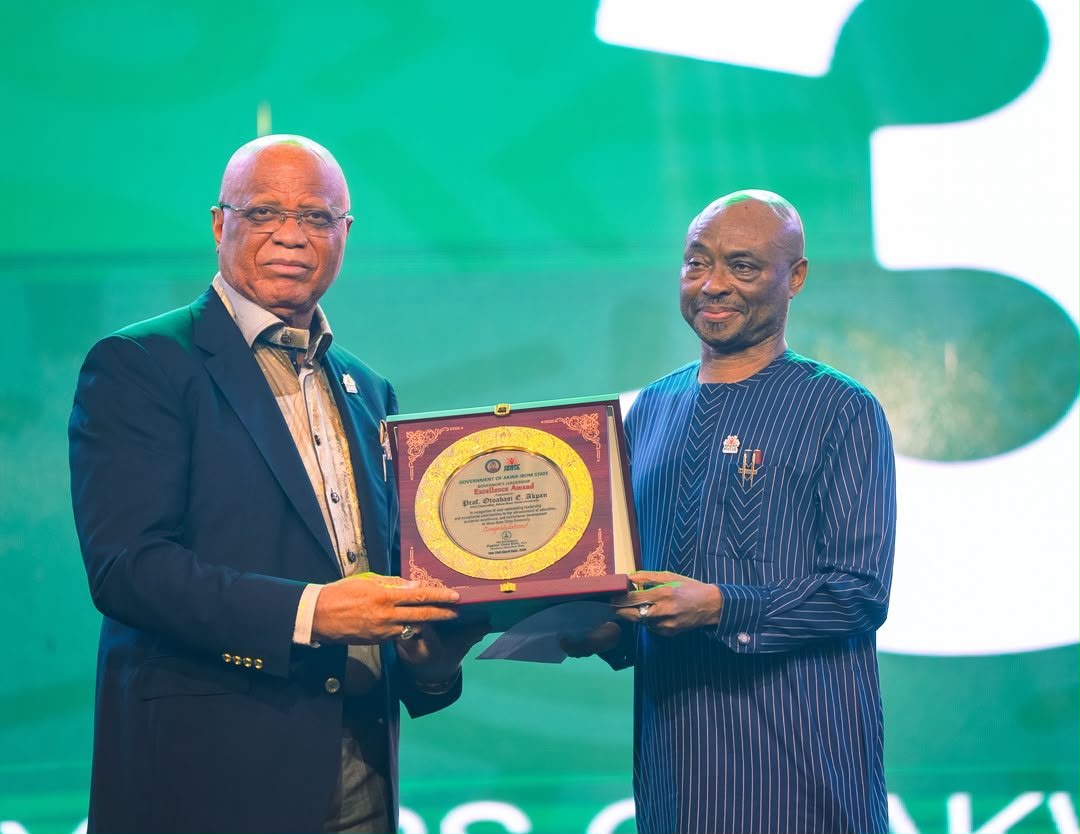
When Governor Umo Eno presented the 2026 Governor’s Excellence Leadership Award to the Vice Chancellor of Akwa Ibom State University, Prof. Otoabasi Akpan, the recognition went beyond an individual university administrator. It highlighted a relationship that has become increasingly consequential to the development of the state-owned university: a Visitor willing to support an institutional agenda and a Vice Chancellor seeking to convert that support into measurable change within the university.
Prof. Akpan, who assumed office in August 2025, inherited an institution with an established foundation but significant room for expansion. Within weeks of assuming office, he produced a blueprint, presented it to the University Senate and College of Professors, and subsequently engaged staff across the main and Obio Akpa campuses on its implementation. This approach placed academic expansion, infrastructure, institutional development and staff welfare within a single framework.
The most visible change has been the expansion of AKSU’s academic portfolio. At the university’s 2026 combined convocation, Prof. Akpan reported that the number of programmes had risen from 66 to 84 during his administration, with 41 new programmes introduced and 43 programmes receiving full accreditation. The number of faculties had also increased from 14 to 17 at that point. Since then, the university has secured further approvals, including Medicine and Surgery, bringing the number of NUC-approved programmes to 85.
The character of that expansion is as important as the numbers. AKSU has moved further into professional disciplines that had previously been absent or limited within the institution. Law received NUC approval to commence in the 2025/2026 academic session, while Pharmacy, Nursing Science, Public Health and other professional programmes have also formed part of the university’s expansion. The September approval of Medicine and Surgery now opens another major academic and professional pathway for students within Akwa Ibom and beyond.
Governor Eno’s role in this process has been that of Visitor of the state-owned institution, with his administration providing support for the university’s operations and development. At the April 2026 convocation, the Governor publicly commended Prof. Akpan for what he described as his commitment, diligence, humility and collaboration, while the university’s leadership acknowledged the State Government’s support as part of the environment in which the recent expansion has taken place.
One of the clearest examples of that support was the restoration of the university’s convocation cycle. AKSU had accumulated a backlog spanning several academic sessions, with graduates awaiting formal convocation and the associated conferment of degrees. In 2026, the university held combined convocations covering multiple cohorts. By the April ceremony, 6,793 undergraduate students and 746 postgraduate students had graduated across the 9th, 10th, 11th and 12th convocations, including 135 first-class graduands.
For the graduates, the significance was more than ceremonial. Convocation completes an important academic process by formally recognizing graduates and conferring their degrees. Governor Eno’s participation also led to a further intervention: he authorized the exploration of employment opportunities for first-class graduates of the university and selected former students with master’s and doctoral qualifications. The measure linked academic performance with a possible pathway into public service.
Infrastructure has been another part of Prof. Akpan’s strategy. The expansion of programmes created an immediate demand for teaching and learning spaces, particularly because some existing facilities had become unsuitable or underutilized. The Vice Chancellor has described efforts to renovate previously dilapidated spaces, while additional classroom projects involved TETFund, private organizations, associates and other partners. The model reflects his stated effort to deploy his professional and social networks alongside institutional resources to meet AKSU’s infrastructure needs.
That partnership model is particularly relevant to a state university because government funding alone does not necessarily provide every resource required by a growing institution. The AKSU administration has therefore sought contributions from alumni, private organizations, academics, former students and other benefactors. Prof. Akpan has described this as the deployment of social capital, drawing on relationships developed throughout his academic career to supplement formal institutional resources.
The university’s growing demand provides another measure of the change. According to Prof. Akpan, AKSU was attracting fewer than 2,500 first-choice applicants before the recent expansion, whereas the figure reached about 8,000 in the 2026 admission cycle. Student enrolment, meanwhile, has risen from about 10,000 to 15,000. These figures indicate that the expansion of programmes is being accompanied by stronger demand for the university’s offerings, although sustaining that growth will require corresponding investment in staff, facilities and academic quality.
The academic profile of the institution is changing alongside its size. AKSU has expanded access through initiatives including JUPEB, part-time degree programmes and a top-up conversion programme, while continuing to develop postgraduate education and research. Under Prof. Akpan’s leadership, the university has also maintained scholarly activities, including inaugural lectures, and introduced new academic and cultural initiatives.
There is therefore a discernible division of responsibility within the partnership. The Visitor provides institutional backing and state-level support, while the university management is responsible for translating that support into academic programmes, accreditation, infrastructure, research, administration and student services. Governor Eno’s public commendation of Prof. Akpan, followed by the Excellence Leadership Award in September, reflects the State Government’s recognition of the administrative progress recorded during the Vice Chancellor’s tenure.
The more important test, however, lies beyond the award itself. Universities are judged over time by the quality of their graduates, the strength of their scholarship, the credibility of their programmes, the quality of their facilities and their ability to respond to the needs of the societies they serve. For AKSU, the rapid expansion under Prof. Akpan has created both opportunity and responsibility: every new programme, faculty and facility must eventually translate into academic capacity and institutional value.
For Governor Umo Eno, AKSU provides one of the clearest institutional expressions of the administration’s emphasis on education and human-capital development. For Prof. Otoabasi Akpan, the period since his appointment has been an exercise in turning an institutional blueprint into visible change. Between the two is a partnership whose most tangible evidence is now found not in statements but in the university itself: more programmes, more professional disciplines, more graduates, expanded facilities and a growing academic mandate.
The story of Umo Eno in AKSU is consequently also the story of what can happen when political authority and university administration work towards a defined institutional objective of mutual partnership and community development. The Governor’s support does not replace the work of the university, just as the Vice Chancellor’s reforms cannot substitute for the resources and policy backing required of the Visitor. The progress recorded so far has emerged from the interaction between the two.
AKSU is still a work in progress. In just a year after Prof. Akpan assumed office, the university has already entered a distinctly different phase of its institutional development. The Governor’s award to the Vice Chancellor therefore arrives at a moment when the central question is no longer whether AKSU can expand, but how effectively it can consolidate that expansion into a stronger and more competitive university.