
Securing the Future: Why Prof. Ekong Makes Security a Priority at UniUyo


By Nsisong Samuel
A university may have brilliant minds, magnificent structures, modern laboratories and ambitious academic programmes, but without a secure environment, the pursuit of excellence remains vulnerable. Security is therefore not merely an administrative responsibility; it is one of the foundations upon which a productive university community is built.
This understanding appears to be central to the administration of the Vice-Chancellor of the University of Uyo, Professor Christopher Nyong Ekong, whose administration has continued to place the safety of lives and protection of institutional property among its important priorities.





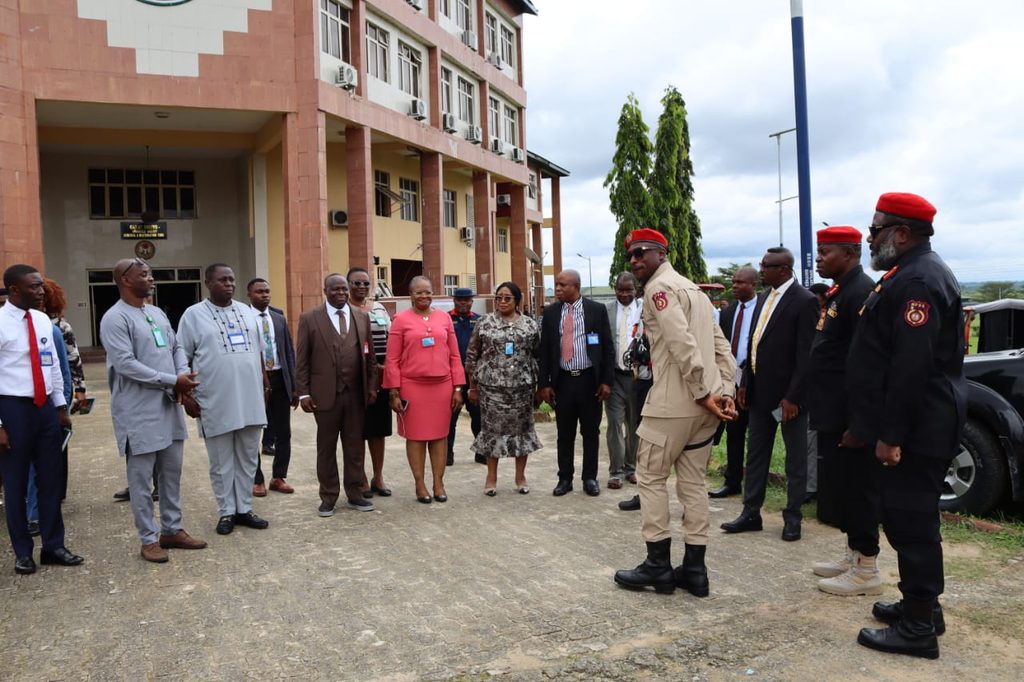
A significant step in this direction was the commissioning of the Nigerian Forest Security Services (NFSS), inaugurated on Monday, September 28, 2026, to strengthen security within the University environment. The initiative underscores a fundamental principle of university administration: there can be no meaningful academic endeavour where members of the academic community are threatened or where institutional property is inadequately protected.
At the commissioning, Professor Ekong charged the security personnel with the responsibility of protecting lives and property. The charge carries significance beyond the routine duties of security personnel. It reflects an understanding that the University’s academic mission is directly connected to the safety and wellbeing of the people who make that mission possible.
Students cannot learn effectively when they are consumed by concerns about their personal safety. Lecturers cannot give their best to teaching and research in an atmosphere of insecurity. Researchers cannot confidently conduct experiments where laboratories and equipment are vulnerable. Administrators and other members of staff equally require a secure working environment to discharge their responsibilities effectively.





Security, therefore, is an enabler of academic excellence.
The decision to strengthen the University’s security structure through the Nigerian Forest Security Services also reflects the reality that contemporary university environments have become increasingly complex. Universities are communities of considerable human, intellectual and material value. They accommodate thousands of students and staff and contain laboratories, libraries, offices, lecture theatres, hostels, research equipment, vehicles and other critical assets. Protecting such an environment requires vigilance, professionalism and an organised security response.
But beyond the physical presence of security personnel is the confidence that such an arrangement inspires. A university community functions better when its members know that deliberate systems exist for the protection of lives and property. Security creates an atmosphere in which students can focus on their studies, academics can concentrate on teaching and research, and the institution can pursue its developmental agenda with greater confidence.
Professor Ekong’s emphasis on security consequently speaks to a broader conception of university leadership. University development is not only about constructing buildings, procuring equipment or expanding academic programmes. It is equally about creating an environment in which people and institutional investments are protected and can function effectively.
The University’s infrastructure represents substantial investment, but its most valuable asset remains its people. Students are the reason the university exists; academics and researchers drive its intellectual enterprise; non-teaching staff sustain its administrative and technical operations; and the University’s facilities provide the physical environment in which these activities take place. Protecting one without protecting the others would be an incomplete approach to institutional development.
The inauguration of the Nigerian Forest Security Services on September 28, 2026, is therefore significant not simply because another security organisation has been introduced into the University environment, but because it reinforces the administration’s commitment to creating a safer and more orderly academic community.
It is a reminder that excellence does not happen in isolation. It requires an enabling environment. It requires stability. It requires confidence. And, above all, it requires security.
For Professor Ekong, the message appears unmistakable: a university that seeks to secure its academic future must first secure the environment in which that future is being created.
The University of Uyo is a community of knowledge, but knowledge needs a safe environment to flourish. By giving deliberate attention to the security of lives and property, the Vice-Chancellor is not merely responding to a security responsibility; he is strengthening one of the foundations upon which the University’s broader pursuit of excellence rests.
Secure the people. Protect the property. Create the environment. Then let scholarship flourish.